Not a fact anymore

The Milky Way contains essentially the entire universe.

What we know now

The Milky Way is one galaxy among an enormous population of other galaxies spread throughout the observable universe.

Why it changed

Improved distance measurements resolved individual stars in spiral nebulae such as Andromeda. Edwin Hubble's observations of Cepheid variable stars showed that these objects were far beyond the Milky Way.

Status
Overturned
Category
Astronomy
Accepted for
≈40 years
Accepted approximately
Late 19th and early 20th centuries
Changed approximately
1920s
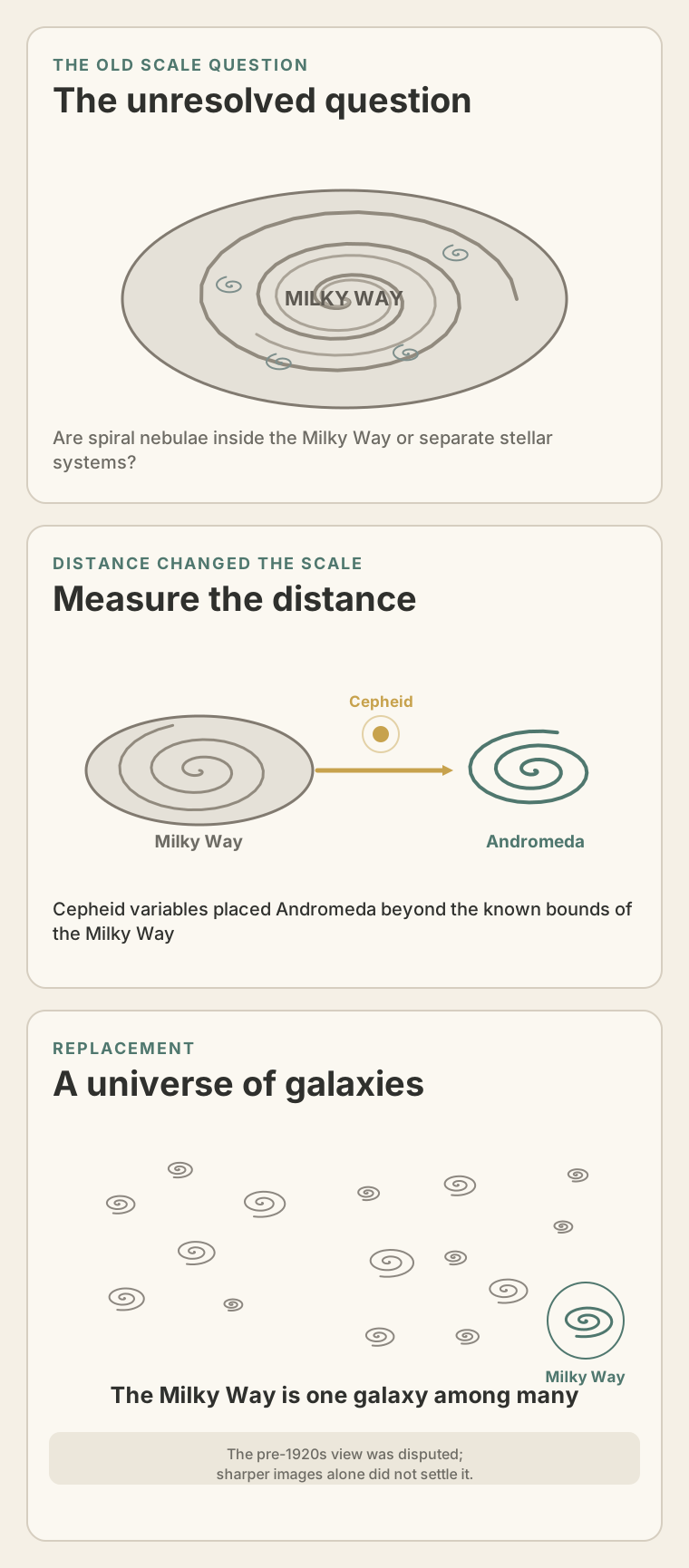
Two-stage scale diagram. The first shows spiral nebulae placed within a large Milky Way representing nearly the whole known universe. The second uses a distance measurement to place Andromeda outside the Milky Way and shows additional galaxies beyond it.

The crucial change was one of measured distance. Once Cepheid variables placed Andromeda far beyond the known extent of the Milky Way, the spiral nebula could no longer be an object inside our Galaxy: the Milky Way became one galaxy among many.

Original graphic: Not a Fact AnymoreOriginal graphic

At the start of the twentieth century, astronomers knew that the Milky Way was an enormous stellar system, but the status of the faint spiral nebulae remained unresolved. Were they objects inside our Galaxy, or distant “island universes” comparable to the Milky Way itself?

The dispute was serious enough to produce the 1920 Great Debate between Harlow Shapley and Heber Curtis. Shapley’s enlarged estimate of the Milky Way made it easier to place the spirals inside it, while Curtis argued for an extragalactic interpretation.

The decisive evidence was distance. Edwin Hubble identified Cepheid variable stars in the Andromeda nebula and used their period–luminosity relationship to estimate a distance far beyond the known bounds of the Milky Way. Andromeda was not a nearby cloud inside our Galaxy; it was another galaxy.

Similar measurements rapidly expanded the universe from one stellar system to a cosmos filled with galaxies.

The pre-1920s view was not unanimous, and the change did not come merely from sharper photographs. It came from turning visible objects into measured distances. The Milky Way went from being plausibly almost everything to being one galaxy among an immense population.
Evidence

Sources and what they establish

Previous belief

Historical context

  • The Great Debate: What Really HappenedNASA Astronomy Picture of the Day

    Provides historical material on the debate over whether spiral nebulae were inside the Milky Way or separate island universes.

Current evidence

Related entries

Or go somewhere else: