Not a fact anymore

Pluto is the ninth planet of the Solar System.

What we know now

Under the International Astronomical Union's 2006 definition, Pluto is a dwarf planet because it has not cleared the neighbourhood around its orbit. The Solar System has eight objects formally classified as planets.

Why it changed

The discovery of Pluto-like bodies in the Kuiper Belt, especially Eris, forced astronomers to define more explicitly what qualifies as a planet. The IAU adopted a formal definition in 2006 and placed Pluto in the dwarf-planet category.

Status
Reclassified
Category
Astronomy
Accepted for
≈76 years
Accepted approximately
1930–2006
Changed approximately
2006
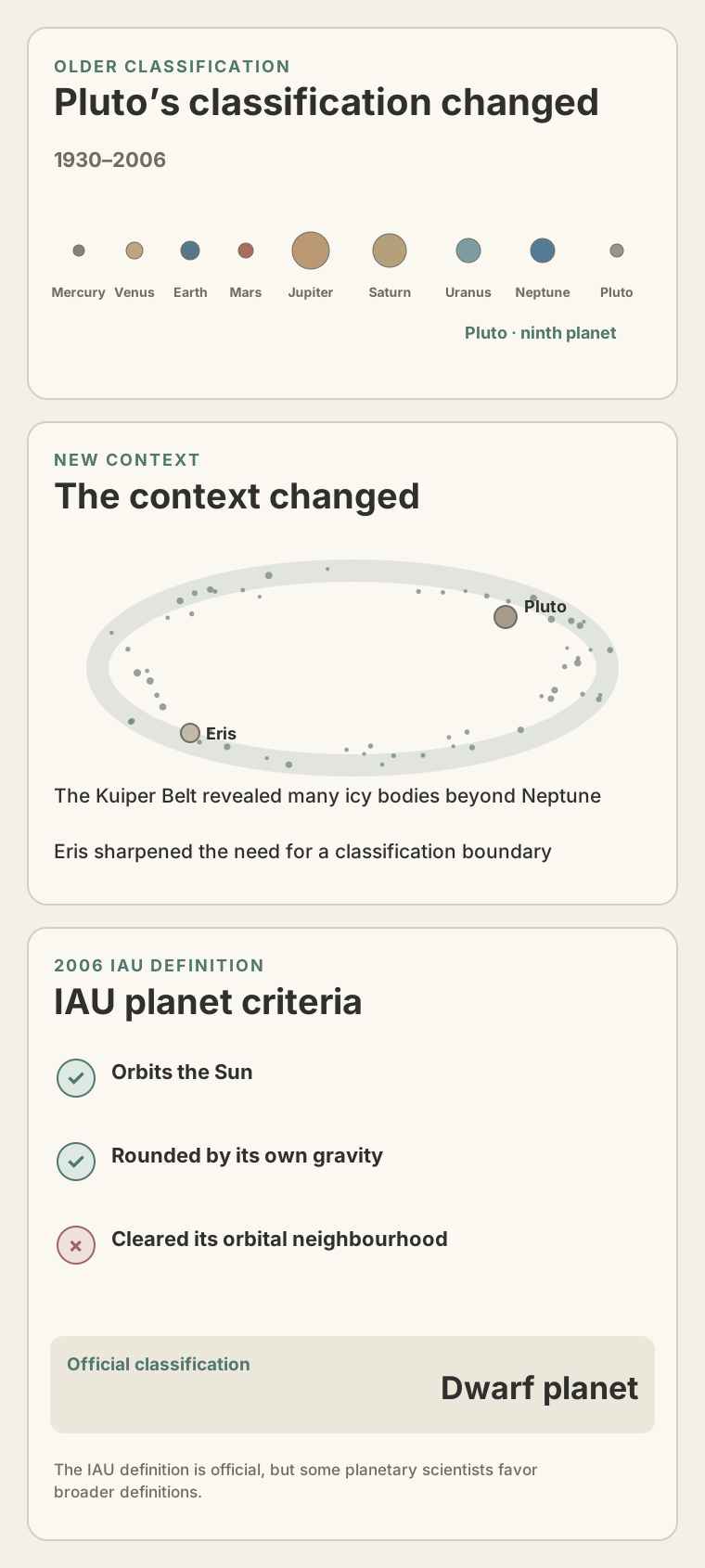
Classification diagram. An older Solar System row labels Pluto as the ninth planet. A second view places Pluto with other Kuiper Belt objects and lists the IAU criteria: orbit the Sun, be rounded by gravity, and clear the orbital neighbourhood. Pluto meets the first two but not the third.

Pluto did not physically change in 2006; its classification did. Discoveries in the Kuiper Belt placed it among a broader population of icy bodies, and under the IAU’s Solar System definition it is a dwarf planet because it has not cleared the neighbourhood around its orbit.

Original graphic: Not a Fact AnymoreOriginal graphic

For 76 years after its discovery, Pluto appeared in textbooks as the Solar System’s ninth planet. Its unusual orbit and small size were known, but there was no formal definition that clearly excluded it.

The discovery of the Kuiper Belt changed the context. Pluto began to look less like a lone odd planet and more like a large member of a broad population of icy bodies beyond Neptune.

The issue became unavoidable after the discovery of Eris, an object then thought to rival or exceed Pluto in size. Astronomers faced a classification problem: add more planets as similar bodies were found, or define a boundary.

In 2006, the International Astronomical Union adopted a formal Solar System definition. A planet must orbit the Sun, be rounded by its own gravity, and have cleared the neighbourhood around its orbit. Pluto satisfies the first two conditions but not the third, so it was placed in the new dwarf-planet category.

Nothing physical happened to Pluto in 2006. This was a taxonomic change prompted by new context.

Some planetary scientists still favor broader geophysical definitions that would call Pluto a planet. The card describes the official IAU classification, not universal agreement over terminology.

Evidence

Sources and what they establish

Historical context

  • Pluto FactsNASA

    States that Pluto was long considered the ninth planet and was reclassified as a dwarf planet in 2006.

Current evidence

Primary research

  • List of IAU ResolutionsInternational Astronomical Union

    Provides the official 2006 Resolutions B5 and B6 on the definition of a planet and Pluto.

Related entries

Or go somewhere else: